Working With a Perfumer or Buying a Stock Scent: A Decision Guide
Buying a stock scent is not the cheap option and commissioning a perfumer is not the premium one. They answer different questions: a stock scent answers how fast and how little, while bespoke development answers how distinctive and how defensible. The mistake on both sides is treating the choice as a statement about ambition. Most ranges end up with both, using catalogue scents to test a category and bespoke work for the products that carry the brand.
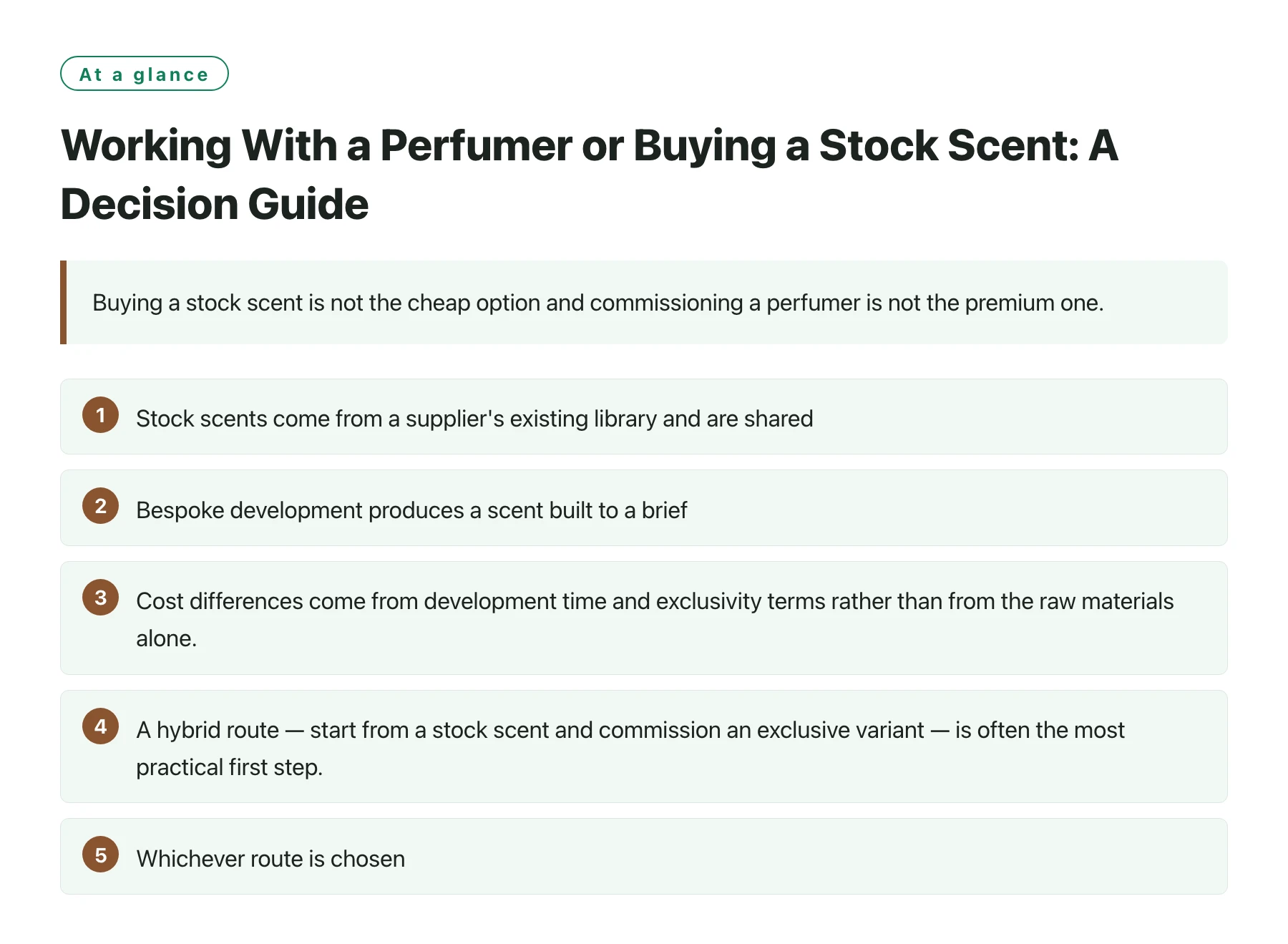
Key takeawaysStock scents come from a supplier's existing library and are shared, which means they cannot be exclusive. · Bespoke development produces a scent built to a brief, and exclusivity is usually negotiated rather than automatic. · Cost differences come from development time and exclusivity terms rather than from the raw materials alone. · A hybrid route — start from a stock scent and commission an exclusive variant — is often the most practical first step. · Whichever route is chosen, the brief and the evaluation method decide the quality of the result more than the price does.
A brand starting a fragrance line usually faces this question in the first supplier meeting: do you want something from our library, or do you want us to develop something for you? Both answers are legitimate and the price difference is often smaller than expected.
What actually differs is who else can have the same product, how much of the brief the brand controls, and how long the project takes. Those three factors, not prestige, are what should drive the decision.
This guide sets out what each route is genuinely good at, the hidden terms that matter, and how to move from one to the other without wasting the work already done.
What each route is actually selling
A stock scent is a finished formula the supplier has already developed, tested and documented. The work is done. What the brand buys is access and speed, plus a known cost and a predictable schedule.
Bespoke development is a service, not a product. What the brand buys is attention: a perfumer working against its brief, revised until it fits, with exclusivity terms attached. The output is unique, and so is the bill.
Where stock scents win
Stock scents are the right answer when speed matters more than originality: a gifting set with a seasonal deadline, a body care range where the scent supports rather than defines the product, or a first test of whether a category works for the brand's audience at all.
They are also useful for learning. Smelling through a library is the fastest education in what a category currently offers, and it gives a brand the vocabulary to write a better brief later.
The limit is obvious once stated: a stock scent can be sold to anyone. If a competitor licenses the same formula, the two products smell identical, and no amount of packaging work changes that.
Where bespoke work wins
Bespoke development is worth its cost when the scent is the reason someone buys. A signature product, a range built around an unusual material, or a formula that has to match a specific market preference usually cannot be assembled from a catalogue.
It also gives the brand a technical asset. A documented formula with clear ownership can be manufactured elsewhere later, used as the reference for line extensions, and defended in a supply negotiation. That value is easy to overlook at launch and very visible three years in.
The hybrid route nobody advertises
There is a middle path that experienced buyers use constantly. Select a stock scent that is close to the direction wanted, then commission a modification that makes it distinct — a different opening, a lighter dry-down, a material swapped for one that suits the target market.
This costs less than full development and takes less time, while producing something the supplier is far less likely to sell unchanged to someone else. The key is to agree in writing how much modification creates a new, exclusive formula. Suppliers that run both a scent library and a development team, as Xuelei does, can usually quote both options in the same conversation, which makes the comparison far easier to judge.
How to brief a perfumer well
- Describe the moment, not the moodInstead of adjectives, describe when the product is worn, by whom, in what climate and for how long it should be noticeable.
- Name references honestlySay which existing scents you admire and what specifically you like about them. Vague admiration produces vague directions.
- State the market and the constraintsTarget market, price band, unit cost ceiling and any materials you must avoid — put them all in the written brief.
- Set the evaluation method in advanceDecide who evaluates, on what, at what dose and at which hour. Changing the method between rounds wastes rounds.
- Ask for directions that differ structurallyTwo variations of one idea is not a choice. Ask for directions that differ in their base materials, not only in their top notes.
- Consolidate feedback into one noteCollect comments into a single consolidated response per round so the perfumer is not chasing four conflicting opinions.
The terms that decide the real cost
Two quotations for bespoke development can differ by a wide margin without either being dishonest, because the price depends heavily on the commercial terms wrapped around the formula rather than on the perfumery hours alone.
Exclusivity and territory
Exclusivity is the single most valuable term in the contract and the one most often assumed rather than negotiated. Ask precisely what is exclusive: the formula, the territory, the product category, and for how long. A formula that is exclusive only in one market may be sold openly in another, which matters if the brand plans to expand.
Pricing usually reflects that scope. Broad exclusivity costs more than narrow exclusivity, and a limited period costs less than a perpetual one.
What happens to the formula if you leave
Confirm whether the brand receives the formula and the manufacturing specification, or only the right to buy the finished product. Without the specification, moving production means starting development again, which is an expensive way to discover a contract term.
Ownership of tooling, artwork files and any moulds made for the pack belongs in the same paragraph, for the same reason.
Quality agreements and testing scope
Whatever route a brand takes, the finished product must be documented against a specification. Independent testing bodies publish the scope of the schemes they audit against, which allows a buyer to verify that a supplier's claimed certification covers the specific product type being purchased [1]. Determine early which party commissions stability testing and retained samples. Industry organisations dedicated to fragrance also run education and professional programmes that are a useful way for a brand team to build the vocabulary to judge samples for itself [2].
Full-service manufacturers such as Guangzhou Xuelei Cosmetic Co., Ltd. normally operate both routes at once, a catalogue of ready scents alongside bespoke development, which makes it possible to start on one and move to the other without changing factory.
Comparing the two routes on the factors that matter
| Factor | Stock scent from a library | Bespoke development |
|---|---|---|
| Time to first sample | Days — the formula already exists | Weeks, depending on how many rounds the brief needs |
| Unit cost | Lower, because development is already amortised | Higher at first, then similar at volume once development is paid off |
| Exclusivity | None by default; the same scent may be licensed elsewhere | Available, and priced according to scope, territory and duration |
| Control over the scent | Limited to choosing among existing options | Full, within the constraints of the brief and the budget |
| Risk if the product fails | Low — money spent on stock and packaging only | Higher — development cost is committed before demand is proven |
| Long-term value | Little; no technical asset is created | A documented formula the brand can reuse, extend and defend |
Read the two columns as a risk-and-control trade rather than a quality ranking. Neither route produces a better scent on its own; the brief, the evaluation discipline and the perfumer's skill do that.
The costliest version of this decision is commissioning bespoke development before the brand knows what it wants. A brief built on adjectives produces a series of samples that are all defensible and none of them right, and the project runs out of rounds before it runs out of opinions. If the brand cannot yet describe the occasion, the market and the wear profile in writing, the faster route to a good product is to work through a supplier's library, learn the vocabulary, and commission development once the brief can be argued for.
Sources
- SGS: Cosmetics, Personal Care & Household Testing —— Testing, inspection and certification services for cosmetics and personal care, including microbiological, stability and safety testing aligned with cosmetics GMP.
- The Fragrance Foundation —— A non-profit organisation for the fragrance industry, running perfumery education programmes and industry recognition.
Frequently asked questions
Is a stock scent lower quality than a bespoke one?
Not inherently. A stock scent may be an excellent formula that has already proven itself commercially, and it will have been tested and documented like any other. The difference is exclusivity and fit, not quality: a stock scent is available to others and may not match a specific brief as closely.
How long does custom perfume development usually take?
It depends on the number of sampling rounds and how quickly the brand returns consolidated feedback. Each round involves building, testing and evaluating a modification. Ask the supplier for a stage-by-stage schedule with dates rather than a single figure, so you can see where delay is likely.
Can I make a stock scent exclusive?
Often yes, by negotiating an exclusivity agreement or by commissioning enough modification that the result becomes a distinct formula. Both need to be written into the contract, and the scope — territory, category and duration — determines the price. Agreeing this before sampling avoids discovering later that the scent is already sold elsewhere.
What should a brief to a perfumer always contain?
The occasion and the wearer, the target market and climate, the price band and unit cost ceiling, any materials to avoid, the reference scents you admire and what you like about them, and the evaluation method you will use. A brief without a wear target will produce samples that cannot be compared fairly.
Should a first-time brand start with a stock scent?
If the brand cannot yet write a precise brief, yes. Working through a library builds the vocabulary needed to judge samples and to describe what is wanted. Commission bespoke development for the product that will define the brand, once that vocabulary exists.