Running a Mining Meetup: Turning Questions Into an Ambassador Application
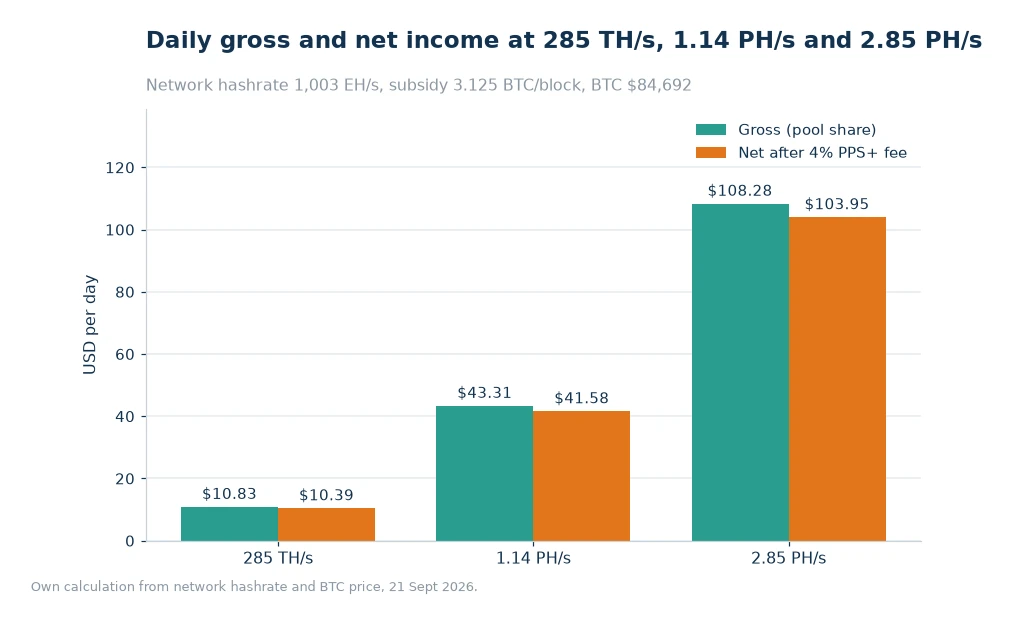
A 285 TH/s demo rig earns 0.00012785 BTC a day, which is $10.83 at $84,692 and $10.39 after the listed 4% on the block-reward component. Put that rig in front of a room and the questions arrive faster than the hashrate: what does it cost to run, why does the number move, what happens when a board dies. A meetup is a teaching format before it is a marketing one.
Key takeaways
- 285 TH/s produces 0.00012785 BTC a day, or $10.39 net after the listed 4%.
- The ambassador role suits people who already explain mining to a regular audience.
- Prepare attendance, cadence and sample material before applying.
- Teach the arithmetic and the risks; never present an output figure as a promise.
The room asks better questions than a forum
Online, a beginner can read twenty answers and still not understand why the daily number fell. In a room with a running machine, the same beginner hears the fans, sees the meter, and watches the balance move hour by hour. That physical sequence answers questions that text threads keep re-opening, and it produces a specific kind of question: how much does this cost me, and what do I do when it stops.
If you already host that kind of gathering, even informally, you are doing most of the work an ambassador does. The remaining step is structure: a repeatable format, a record of who came, and material that can be reused. That structure is also what an application asks for, which is why the two activities overlap more than they appear to.
What the program is, and what it is not
The ViaBTC Ambassador Program is a structure for people who introduce miners to the pool: a way to formalise the explanations, the events and the introductions that already happen. It is not a licence to promise returns, and it is not a substitute for the support documentation. Anyone considering it should read the program page and the guides before deciding what they can honestly offer.
The application step is deliberately plain: Apply for Ambassador, describe the audience, and show what you would do. That is easier for someone with a track record than for someone with an audience in theory. A person who has run six monthly sessions with fifteen attendees has evidence; a person with a large follower count and no sessions has a claim. Build the evidence first if it does not exist yet.
Preparing the evidence
Four facts make a credible application: how many people attend, how often, what the format is, and what they take away. Attendance can be a range. Cadence can be monthly. Format can be a ninety-minute session with a short demo and a long question period. The takeaway is the part worth writing carefully, because it is what separates a meetup from a sales pitch.
Add one sample asset: a slide deck, a one-page handout, or a recorded ten-minute walkthrough. A handout that explains the difference between a gross and a net credit is more persuasive than a logo on a banner. If you have none of these, write the handout now; it is a weekend of work and it becomes the spine of every future session. Keep it to two sides of paper, because a handout people actually carry home beats a folder they leave on the chair.
Teaching the numbers without promising an outcome
The demo rig is the most direct teaching tool because it forces arithmetic. At 285 TH/s the daily gross is $10.83 at today's price and the net is $10.39 after the listed 4% on the block-reward component. Show the division: 450 BTC a day across 1,003 EH/s, then multiply by the rig's share. When someone asks whether that will still hold next month, point at the difficulty estimate — −2.12% on 21 Sept 2026 — and explain that the estimate itself changes.
Two habits keep the session honest. First, always say "at today's difficulty and price" when quoting a figure, and say it every time rather than once at the start. Second, show the cost side on the same slide: power, the machine's purchase price, and the fact that a repair can arrive without warning. A room that leaves understanding the cost side asks better follow-up questions and trusts the numbers more, not less.
Where the referral link fits
Most organisers already share a link, and the ViaBTC Referral page covers that mechanics separately from the ambassador role. Keep the two distinct in your own mind and in the room: a referral link is a convenience for someone who has decided to try the pool, while the ambassador role is about the sessions, the material and the introductions around it.
Disclose the relationship when you share a link, in one plain sentence, and put it on the handout rather than only in speech. An audience that knows why the link is there can judge the recommendation on its merits, which is the only basis on which a long-running meetup survives. Repeat the disclosure when new people join, since half the room on any given night has not heard the first version.
| Part | What to show | Weak version |
|---|---|---|
| Audience | Attendance range and how people hear about the sessions | A follower count with no events |
| Cadence | Monthly or quarterly dates already held | "I plan to start soon" |
| Material | A handout or recording that explains one concept well | A collection of reposted charts |
| Disclosure | A sentence naming the relationship, on the material | Links shared without context |
Worked example
Use the room itself as the scaling exercise: ten attendees, each with a rig like the demo unit.
- Each day the chain issues 144 × 3.125 = 450 BTC to miners.
- That works out to 0.00000044865 BTC per TH/s across 1,003,000,000 TH/s.
- One demo rig at 285 TH/s: 0.00012785 BTC a day.
- At $84,692: 0.00012785 × 84,692 = $10.83 gross.
- After the listed 4%: 10.83 × 0.96 = $10.39 net.
- Ten such rigs: 2,850 TH/s, or 2.85 PH/s, and $108.28 gross a day.
- Net for the group: 108.28 × 0.96 = $103.95 a day, or $3,118.50 over 30 days.
- Halve the BTC price and the dollar figures halve with it, while the BTC credits stay the same — the slide that makes this point is the one people remember.
Frequently asked questions
Do I need a large audience to apply?
No. A regular session with a dozen attendees and a clear format is stronger evidence than a large but passive following, because it shows the work the role actually involves.
Should the meetup include a live miner?
If the room allows it, yes. A machine running at 285 TH/s makes the credit, the noise and the power draw concrete, and it turns an abstract daily figure into something the audience can watch change.
How do I talk about income without overpromising?
Quote figures with their inputs attached, such as $10.39 a day at 285 TH/s, 1,003 EH/s and $84,692 per BTC, and show how difficulty and price change both the coin and dollar totals.
Start with the next session
Book the date before writing the application. A session with a fixed room, a demo rig and a one-page handout produces the attendance, cadence and material that an application needs, and it produces them honestly. Then apply with those facts rather than with intentions, and keep the handout updated as conditions move.
The ViaBTC App is worth installing on the demo phone, because a live worker list answers the question every beginner asks first: is it actually running right now. Everything else in the session is arithmetic, and arithmetic is teachable.
Sources: ViaBTC ambassador, referral and app pages for program scope and the listed 4%[1]. Chain snapshot 21 Sept 2026: 1,003 EH/s hashrate, 132.76 T difficulty, 3.125 BTC subsidy per block, 144 blocks a day, BTC $84,692. Published 24 Oct 2026.