Risk Review: Reviewing factory capacity and production records
A factory’s stated monthly capacity is a claim that needs context. Buyers should examine equipment, process sequence, staffing, shifts, current order load, materials, bottlenecks, and actual records for comparable products. Production data can reveal whether a promised schedule is realistic and whether reported output is supported by traceable quality and shipment evidence.
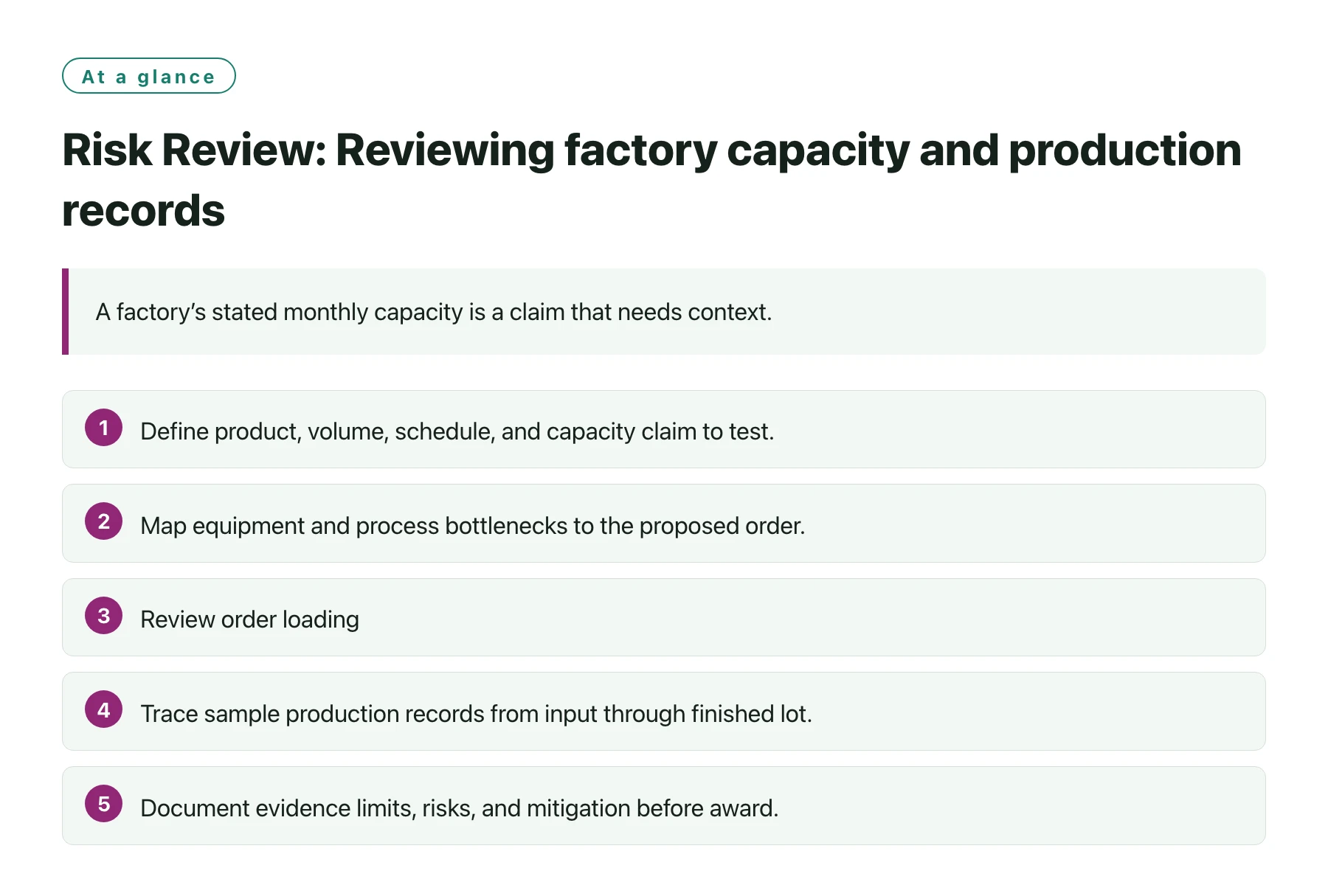
Key takeawaysDefine product, volume, schedule, and capacity claim to test. · Map equipment and process bottlenecks to the proposed order. · Review order loading, work in progress, shifts, and material constraints. · Trace sample production records from input through finished lot. · Document evidence limits, risks, and mitigation before award.
Capacity review is strongest when a claimed output rate is connected to actual process steps and recent production records.
1. Define the capacity question
Specify product family, target quantity, required start and finish dates, peak volume, and whether output must be dedicated or can share a line. Clarify whether the claim is theoretical machine capacity, installed capacity, historical output, or free capacity available for the buyer’s order.
Ask for capacity by operation and time period, not only an annual total. Distinguish one-shift and multi-shift output, standard product from customized work, and planned capacity from proven production. State what evidence would support the claim.
2. Map the process and identify constraints
Trace major steps from incoming materials through fabrication, assembly, finishing, testing, packing, and dispatch. Identify equipment, cycle times, changeovers, batch sizes, skilled operators, outsourced processes, and inspection queues at each stage.
Find the limiting operation. A fast assembly line cannot compensate for slow finishing or a long-lead imported component. Ask how the factory handles product mix, tooling change, maintenance, rework, and simultaneous orders competing for the same resources.
3. Check the equipment and staffing basis
Record equipment type, quantity, age or condition where relevant, location, working status, and process suitability. Observe setup and operation where access allows. Verify whether machines are available for the proposed schedule or shared with other product lines.
Review staffing by shift, operator qualification, overtime assumptions, absentee coverage, and supervisory support. A capacity plan that depends on unconfirmed hiring or sustained overtime should be identified as conditional. Ask who owns workforce planning and when resource gaps will be escalated.
4. Review order loading and work in progress
Request an order schedule for the relevant line, with buyer-independent identifiers masked if needed. Compare existing committed quantities, due dates, priority, and WIP stage with the new order. Look for conflicts between promised capacity and the same machines or people allocated elsewhere.
Verify how the factory updates schedules when orders change and how it distinguishes confirmed commitments from forecasts. Check whether a proposed production slot is reserved, for how long, and what happens if the buyer’s sample or deposit is delayed.
5. Validate material and subcontracting dependencies
Trace critical components and raw materials to approved sources, stock status, lead time, minimum order, and incoming inspection. Ask what evidence supports availability for the buyer’s volume. Identify imported materials or single-source items that could constrain production.
List subcontracted operations, sites, capacity, lead times, and quality controls. Determine whether the factory can monitor outsourced work and retain traceability. A capacity claim that excludes finishing, testing, or packaging may understate the true order lead time.
6. Trace representative production records
Select recent orders for comparable products and trace identifiers through work orders, material issues, process records, inspection results, rework, packing, and dispatch. Confirm dates, quantities, versions, and responsible roles are consistent. Redacted records can still demonstrate structure and traceability.
ISO 9001 describes quality management system requirements and documented information. Reviewing a certificate alone does not establish actual output or product conformity; assess records from the relevant site, process, product, and period. [1]
7. Compare planned output with actual results
Review production start, completion, good quantity, scrap, rework, downtime, and on-time delivery for comparable orders. Ask how definitions are calculated and whether reported output includes reworked or rejected units. Look at multiple periods rather than selecting one unusually strong month.
Compare stated capacity with measured throughput and schedule adherence. Account for product complexity, batch size, setup changes, seasonal demand, and inspection hold time. If the factory’s definition differs from the buyer’s need, restate the usable output calculation.
8. Check record integrity and change control
Confirm records identify product code, drawing revision, site, line, lot, date, materials, operator or responsible role, and disposition. Check how corrections are made, who approves them, and whether originals remain traceable. Avoid relying on isolated screenshots without source context.
Ask how production is controlled after a drawing, material, process, or supplier change. Review examples of change notice, impact review, approval, and effective date. Changes can alter cycle time, yield, test needs, or capacity even when the product name is unchanged.
9. Identify capacity risks and practical mitigations
Rate risks such as overloaded bottlenecks, unstable yields, unconfirmed materials, subcontractor dependency, tooling constraints, high overtime, maintenance backlog, weak records, or inconsistent scheduling. Assign each risk an owner, due date, evidence need, and effect on the committed delivery date.
Mitigations may include a pilot run, staged release, reserved production slot, approved alternate source, additional inspection, or a revised delivery schedule. Verify that a mitigation is actionable and funded rather than just a statement of intent.
10. Document the sourcing decision and monitor the order
Summarize the capacity claim, evidence reviewed, assumptions, bottlenecks, record samples, unresolved questions, and approval conditions. Convert approved output and milestones into the purchase order or production schedule. Define when updated status and escalation are required.
Buyers checking a supplier facility in China can connect capacity review with factory process evidence and order milestones. Recheck during production if actual output, material readiness, or quality results diverge from the plan, and retain records for future sourcing decisions.
Sources
Frequently asked questions
Does installed machine capacity equal available capacity?
No. Consider current orders, staffing, setup time, maintenance, materials, subcontracting, and process bottlenecks.
Which production records are most useful?
Trace a comparable order across work orders, material issues, process checks, rework, inspection, packing, and dispatch.
Should a factory’s annual output claim be accepted at face value?
No. Clarify its definition and compare it with recent product-level throughput and committed workload.
When should capacity be checked again?
Reassess after major schedule changes, new product mix, material disruption, staffing changes, or missed milestones.